Kell Shaw
  • Home
  • Books
    • The Cambion Chronicles
    • The Revenant Records
  • Bonus Shorts
  • Lore
  • About
    • Contact
    • Links
  • Newsletter
  • Blog
Kell Shaw
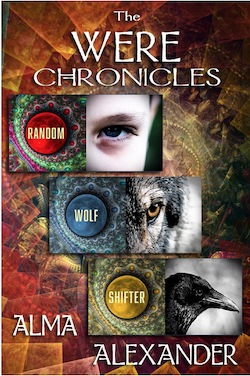
The cover for the Were Chronicles - an abstract cover showing a boy, a wolf and a magpie in three inset photographs against an abstract background.

Written on 07 November 2025. Posted in Blog.

The RIB: The Were Chronicles by Alma Alexander

Werewolves meet X-Men

 The Were Chronicles by Alma Alexander is probably one of my favorite books I’ve read recently. It’s actually three books bundled together, the individual ones being Random, Wolf and Shifter. The introduction posits that it’s a work of ‘Hard Fantasy’, in that the shapeshifting is based on science (the author is a molecular biologist). It’s also a lot more grounded than a lot of fantasy as the book explores the impact of werecreatures on culture, society and on science. (I wouldn’t call it soft sci-fi either, as that always reminds me of Doctor Who, where this is more like Ursula LeGuin playing with urban fantasy tropes.)

Each month, the Were people shift into animal form. It’s not a great existence; they don’t remember their transformations, and have to be kept in cages, lest they run off or hurt people. However, their people are still proud of their heritage and live in large clans that support each other. During adolescence, Weres imprint on an animal that they will turn into for about three days (about the length of a full moon) for the rest of their lives. In a world that reminded me a bit of how the X-Men were treated, Weres are regulated by the government. Weres that don’t have anyone to help them during their transformations are imprisoned in horrific institutions, and there are drugs you can take to suppress (but not completely stop) one’s transformation.

The first book in the collection, Random, is the story of Jazz. As her brother desperately tries to trigger his own transformation as a rite of passage, Jazz’s own transformation is triggered - and she shifts into a human male that resembles her older brother! I was expecting an exploration of gender identity, but it’s really a story of immigrant identity. The focus of the book is a character study of Jazz’s older sister, Celia, her death, and the impact on her family. Jazz reads her sister’s journals and privately blogs about her reaction to them in her internet journal. Celia’s story is about fleeing Eastern Europe, as violence against Weres increases, immigrating to America and trying to fit in. Horror elements are subtly explored through the Turning Houses (where shifters are compulsorily imprisoned by the government each full moon) and the tragic bullying that Celia faces at school. I thought Jazz’s story was largely overshadowed by her sister’s, and yet this thread anchors the entire trilogy.

Wolf is the story of Mal, Jay’s brother. During the events of the first book, he ‘cheats’ to trigger his transformation into a wolf, or Lycan. (He’s friends with ‘Chalky’, a mysterious shifter who can turn into any animal, and he can control and keep his human mind during the transformation, unlike the after Weres. And when Chalky bites Mal, he triggers Mal’s transformation into a wolf.) Now Mal is a member of one of the oldest and most mysterious Were clans. The Lycans come for him and indoctrinate him into their society - and they’re all biologists! Mal is taken to the compound and trained in basic labwork. Each month, Mal enters the wolf sanctuary in wolf form. This is probably one of the most original werewolf society studies I’ve read about. It’s a social story about Mal finding a place in the Lycan society and culture when he’s an outsider to such a closed and cliquey group, obsessed with research, family bloodlines and academia. It’s also about a younger generation rising up and challenging the status quo. This was my favourite story in the book.

Shifter is the story of Chalky (alias Saladin) Mal’s friend, who can shift into any shape. He starts off using it for mischief, and then by the end of the book is involved in a full-blown spy plot against the religious authoritarian movement that’s cracking down on Weres.

Overall, I loved the world-building and the character studies. Alexander’s background as a scientist underlies the trilogy, grounding the story in interesting ways. Especially with extracts of academic reports and papers sprinkled through the books. Probably my main caveat is that Alexander spends a chunk of the second book covering the events of the first, and most of the last book covering the events of the second from Chalky’s point of view. It’s fantastic from a character perspective, but by the time we catch up to events, the plot becomes a bit squished, and could have used longer to explore the intrigue that Chalky gets involved in. Anyway, it was a fascinating dive into ‘Hard Fantasy’ and a highly recommended read, particularly if you want to read a book that explores werecreatures in a different light.

No comments
  • book review
  • RIB
  • review of interesting books
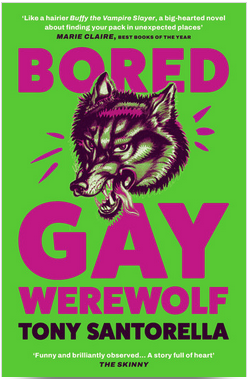
The green cover for Bored Gay Werewolf. Depicts an angry wolf head.

Written on 16 October 2025. Posted in Blog.

The RIB: Bored Gay Werewolf by Tony Santorella

Fight Club with Werewolves

 Bored Gay Werewolf is about Brian, a guy whose life has been so upended by his werewolf curse that he’s dropped out of college, doing drugs and working as a waiter in a dead-end bar. He’s got friends, but he doesn’t let them in, and he’s drifting aimlessly through a dull life of empty Grindr pick-ups until the next full moon.

 Brian doesn’t have great control over his transformation and in fact he's accepted that he might commit the occasional, accidental murder every full moon.

 Then he meets another werewolf: Tyler Gainsborough, whose business card reads ‘Entrepreneur and Business Coach’. Tyler’s looking for other werewolves that he knows are out there, hiding, and he’s got a plan: he’s going to set up an app for them, filled with inspirational articles on how to be an alpha in your personal and professional life. He also offers to coach Brian on how to control his werewolf side better.

 Initially, Brian rebuffs Tyler, but slowly falls under his charm. Brian joins a world of start-up business culture, training, protein shakes, martial arts and meditation. He writes articles for the upcoming werewolf website. At first, Brian’s encounter with Tyler’s world has positive effects - he works out regularly, shakes off his rut, and can control his werewolf transformations. Except, he also becomes a jerk to his previous friends as he embraces the new world of masculinity he’s getting into.

Then everything comes to a head when Tyler gets frustrated with his inability to find other werewolves. He proposes another plan - why find other werewolves where you can make them? And what will Brian do when he’s caught between his old friends and his increasingly unstable mentor?

 While werewolf urban fantasy has its own little niche of alphas, betas and hot shirtless guys, this book is more at the gay fiction end of the spectrum - exploring more about culture, identity and masculinity. Who are your real friends? How do you reconcile being a tough man in today’s culture when you’re also gay and sensitive? 

 The book’s written in a heavy exposition, present-tense style that reminded me of Chuck Palahniuk’s Fight Club, and the satire of bro-culture also balanced by reveals amongst Brians’ friend group and a sense of a deeper fantasy world and community out there that’s beyond what Brian knows. A good read.

No comments
  • book review
  • RIB
  • review of interesting books
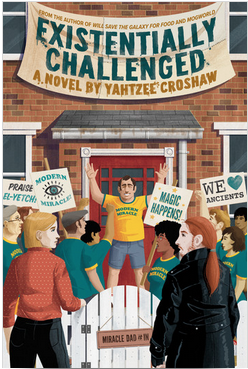
The cover of Existentially Challenged, showing people protesting outside a man's house

Written on 12 September 2025. Posted in Blog.

The RIB: Existentially Challenged by Yahtzee Croshaw

Existentially Challenged is the sequel to last month’s book review, Differently Morphous by Yahtzee Croshaw. Once again, Croshaw has a refreshing take on urban fantasy by showing the impact of magic being revealed to the world.

 This book’s focus in on religion. Magic in this universe comes from bargains or possession by one of the Ancients, Cthulhu-esque entities that live outside of space and time. Like gods. And if you can prove that there are gods that are real and grant power, how does that affect people’s beliefs?  Crowshaw’s tackles this theme with his subversive sense of humour.

 A year after the events of Differently Morpheus, the Extradimensional Appropriation Act is passed that makes it illegal for people to claim to have magic. (Cue a nice gag scene where a group of stage magicians have to admit that they are cold reading people to stay ‘legal’ during performances). 

 The Department of Extradmensional Affairs (or DEDA) is empowered to investigate claims of magic. Their current case is where a young girl, Miracle Meg, can heal people through her connection with her Ancient, El-Yetch. Genuine faith healing! However, a few suspicious corpses of people horribly aged to death are found in the area, which suggests that this healing isn’t as genuine as it appears. 

Alison Arkin and her over-the-top partner Doctor Diablerie (think of a dramatic 1930s villain in top hat and tails) investigate what’s really happening with Miracle Meg, and her family, Miracle Dad and Miracle Mum. The role of the internet is a big part in the Miracle Meg case, with her followers big on the forums, her father desperate for fame and television appearances, and a group of Youtubers in a van (with a dog) following the case and making things more complicated for Alison.

 Several subplots weave in the background for the other DEDA agents. Pyrokinetic Victor Casin tangles with a woman possessed by the same entity that empowers him. Is she his girlfriend or his archnemesis? Or is that one and the same? And Adam Hesketh struggles with his first proper investigation that isn’t a seek and destroy mission. And he’s terrible at it. Alison tries to piece together Diablerie’s real backstory and agenda; what’s he actually planning?

 Despite their powers, the DEDA agents aren’t the world’s sharpest lot. They blunder their way through events, making disastrous decisions, but get there in the end. The story’s told through a mix of regular third person narrative, internet forum chats and other extracts. The book skewers the religion and the media, particularly in a great scene where the Christian Church is accused of breaking the Extradimensional Appropriation Act, culminating in a late-night television debate between followers of El-Yetch and hardline pastors.

 I enjoyed the first book more (the mystery was tighter) but this is still an entertaining read. I liked how the characterisations of the DEDA were dug into a bit more. And I’m looking forward to the next one, and discovering Doctor Diablerie’s secret agenda…

No comments
  • book review
  • RIB
  • review of interesting books

Written on 20 August 2025. Posted in Blog.

WordPress to Joomla!

I want to blog about my Joomla update.

So, I was thinking of updating my WordPress website late last year. I had so many plugins my dashboard was flickering with ads, and my list of pages had a warped layout because of extra columns, inserted by said plug-ins. I didn’t like the layout or how I’d set things up. Time for a rebuild.

And then the WordPress drama happened, and I was like, right, what else is out there? Is WordPress the ultimate open source blogging these days?

No comments
  • author business
  • technology
  • website
  • joomla

Read more: WordPress to Joomla!

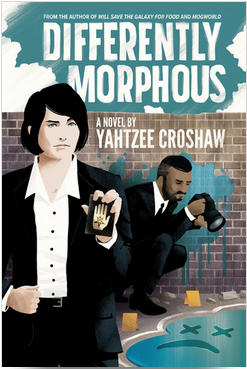
The cover of Differently Morphous, showing Alison holdng up her badge. I'm not sure who the chap is behind her, however.

Written on 03 August 2025. Posted in Blog.

The RIB: Differently Morphous by Yahtzee Croshaw

This book stood out while browsing for two reasons. 

One: Yahtzee Croshaw? Didn’t he do those video game reviews back in the day for the Escapist? What’s he doing writing urban fantasy?

And two: based on the blurb, this story is about an urban fantasy reality where the masquerade breaks, and the prosaic world is exposed to magic for the first time. Not something I've encountered a lot of.

Let’s check it out.

The Ministry of Occultism keeps Britain safe from magic and monsters. But their practices are all mired in the nineteenth century. The organisation sponsors demon hunters, is led by a doddery council of robed elders called the Hand of Merlin, and funnels all detected magical practitioners into two schools: a pleasant one designed to find out which people for sure can cast magic, and a more sinister reform school. Rather than being taught to channel the magic and integrate with society, the students are instead treated like prisoners.

Things change when a group of extra-dimensional creatures, called shoggoths by the Ministry, ask for refugee status. Unlike their Lovecraftian namesakes, these shoggoths, or fluidics, are sweet, enthusiastic but bumbling sluglike creatures, eager to integrate with society and eat garbage. They see themselves as part of a whole, rather than as individuals. Usually, the Ministry sends in flannel-clad Yorkshire demon hunters to shoot the fluidics with salt (which kills them) each time they cross over, but in this case, the fluidics contact the well meaning Henry, who stages a public march with a mass parade of the entities. With the supernatural exposed, the Ministry is outed and forced to shed its nineteenth century practices, joining the British government as the Department of Extradimensional Affairs.

Our main protagonist is Alison Arkin, a wannabe magic student, but leaves to work for the Ministry when the teachers discover she doesn’t have any actual powers, only an eidetic memory. After a few disastrous administration assignments, Alison is partnered with field agent Doctor Diablerie, a pretentious and possibly unstable individual who wears a top hat and cloak, and speaks about himself in the third person and who doesn’t appear to have any of his own magic. (I wasn’t sure Diablerie was a Doctor (Who) parody at first, given his bluster and nonsensical babble, but he remains marvelously Over The Top throughout the book, although his presence may be an acquired taste. Despite Diablerie not having any explicit magical abilities (he mostly blusters his way through things) he has a 100 percent case clearance rate.)

While I was initially interested in the Department’s transition into the real world (complete with humorous clashes with more politically correct public service staff and policies) the actual main plot is more of a mystery. Someone is murdering fluidics! Diablerie and Alison investigate, and Alison doggedly pulls everything together. I was pleasantly surprised by the mystery’s pay off - it’s well done. Yahtzee is skilled at setting up a joke or situation that leads to a strong punchline or payoff, even if it’s down the track.

 The tone of the book is humorous, a bit Laundry Files, maybe a touch of Discworld. It took me a while to become fully immersed, but as the cracking plot progressed, I was hooked.

 Anyway, recommended.

No comments
  • book review
  • RIB
  • review of interesting books

More Articles …

  1. The RIB: Luda by Grant Morrison
  2. The RIB: Lord Darcy by Randall Garrett
  3. The RIB: DeChance Chronicles - The Omnibus Collection by David Niall Wilson
  4. The RIB: Last Exit by Max Gladstone

Subcategories

Page 2 of 7

  • 1
  • 2
  • 3
  • 4
  • 5
  • 6
  • 7

Subscribe to the newsletter and get free stories and news.
© 2026 Kell Shaw
  • Home
  • Books
    • The Cambion Chronicles
    • The Revenant Records
  • Bonus Shorts
  • Lore
  • About
    • Contact
    • Links
  • Newsletter
  • Blog